New Chronology Zodiac List

This article contains a list of zodiacs which have allegedly been analyzed in Fomenko’s New Chronology. The zodiacs are ordered based on the dates that they allegedly reveal. If the zodiac’s abbreviation is followed by two ‘*’, this means that two dates are available for that specific zodiac. If the zodiac’s abbreviation is followed by three ‘*’, this means that three dates are available for that specific zodiac. The discoverers of these dates have noted which dates are more likely on some of the multiples, some have been marked accordingly. All dates are AD. There is an alphabetical key that names the zodiacs in the second part of this article. Links to expanded articles are attached to the abbreviations. An abbreviation with ‘!’ after it means that there was no abbreviation provided so I created one for it.

~~~~~ ~~~~~ ~~~~~ ~~~~~

SP** - August 14-16, 969

SN - August 14-16, 1007

MT - August 14-16, 1007

MZ! - 1007

RC** - April 15-16, 1146

SX - June 17-18, 1148

RD - June 16, 1148

AE - 1151 

RG - May 17-28, 1166 

DL - April 22-26, 1168

OU - September 5-8, 1182 

DR - March 20, 1185

YT - September 15, 1186

MB - July 29-August 15, 1200

SP** - August 5-7, 1206

LK - September 14, 1221

P1*** - August 5, 1227 for the outer room

ZA! - August 28, 1228 

AV - May 15-16, 1230

P2*** - March 24-25, 1240 AD for the inner room

AN - February 9-10, 1268 

GA - December 8, 1284

NB** - January 31-February 1, 1285

RS** - February 4-5, 1289; most likely 

KZ - May 6-8, 1308

RC** - April 16, 1325; most likely 

NB** - January 29-31, 1345

EB - March 31-April 3, 1394

EM - May 6-8, 1404

RP** - October 14-16 1405 

FN - May 19, 1421

P1*** - August 10, 1430 for outer room 

DZ! - April 12-15, 1477

P2*** - April 17, 1477

AP! - October 1, 1486

BL - March 16, 1495

GP - November 17-21, 1513 

CN - February 3-4, 1524

VP - February 5-6, 1524

MK - February 10, 1524

PD - March 7, 1524

VP - March 7, 1524

PG - February 9, 1526

DP - February 28, or March 1, 1546 

RS** - February 20-21, 1586 AD

KL - August 30-September 1, 1624

VA - August 31, 1624

LV - June 12-17, old style 1638

OL*** - August 1-2, 1640

VG - December 21, 1656, or December 31, 1656

FS - June 24, old style 1661

RZ - December 8-9, old style 1664

P1*** - August 2, 1667 for outer room

ZP - June 24-30, old style 1670

FR - May 19, old style 1680

FT - October 15, old style 1686 

OL*** - August 2 or August 29-30, 1700 - August 2, 1700 more likely 

P2*** - April 2, 1714 for inner room

KT - March 6, 1725 

FA - June 5, old style 1741 

FZ - July 3-4, old style 1741

RP** - April 23-25, old style 1781

MP** - 1785

MP** - August 11-12, 1843, more likely 

BRb*** - October 7, 1841

BRc*** - February 15, 1853

BRa*** - November 18, 1861

OL*** - June 27, 1877

~~~~~

The 63 horoscopes listed alphabetically:

AE – of Christ

AN – lower Athribian

AP! – Biblical Book of Apocalypse

AV – upper Athribian

BG – Zodiac of Astronomy in the chambers of Pope Alexander Borgia

BL – Bayeux Tapestry

BR – Bruges’ Zodiac

CN – painting of the second Tiburtine room of Villa d’Este

DL – Long Dendera

DP – of Henry II and Diana Poitier

DR – Round Dendera

DZ! – Dante’s Zodiac

EB – Big Church of Esna

EM – Small Church of Esna

FA – of Jove on the carved stone

FN – of Phaeton

FR, FS, FT- of the Scythian chamber of dukes D’Este in Ferrara, in Italy

FZ – of Falconetto from Mantua

GA – of Gemma Augustus

GP – of Heracles

KL – in the portrait of Johann Kleberger by Dürer

KT – of grandson of the Yellow imperator, Xian-Yuan-Shi

KZ – church in Herment

LK – Leo of Commagene

LV – of Louvre

MB – Zodiac of Olympus

MK – in the picture of Carlo Maratta “Apollo chasing Daphne”

MP – mosaics of Raphael in chapel of Chigi of the church of Maria del Popolo in Rome

MT – Metternich stela

MZ! – Zodiac of Mithras

NB – “with dressed Nut”

OL – of Olympians in the villa of Barbaro in Maser

OU – Tomb of Ramses VII in Thebes

PD – of a mediaeval baptistery in Padua

PG – of Ivan the Terrible

P1+P2 – Tomb of Petosiris

RC – Tomb of Ramses IV

RD – Tomb of Ramses IX

RG – Copenhagen golden horn

RP – from the Chamber of Court in Padua

RS – Tomb of Ramses VI

RZ – Zodiac of Marcus Aurelius

SN – Tomb of Senenmut

SP – Tomb of Seti I

SX – Second zodiac of Senenmut

VA – in the hall of Cupid and Psyche

VG – on the ceiling of the hall of Galatea

VP – of Alexander the Great and Roxanne in the hall of Prospect

YT – of the ascension of the Virgin

ZA! – Zodiac of Astronomy

ZP – on the ceiling of the Hall of Pontifexes in Vatican

~~~~~

Below are the books about the above datings followed by a list of the zodiacs they contain in them. There are 55 total that I have determined the literary location for.

The New Chronology of Egypt (2007): DL, DR, EB, EM, AV+AN, BR, OU, P1+P2, SP, SN, KZ, RS, RC. (15 total)

Ancient Zodiacs of Egypt and Europe (2009): MT, NB, RZ, LV, LK, MZ!, BL, RG. (8 total)

Russian and Italian Zodiacs (2009): SX, RD, AE, PG, FA, GA, DP, PD, ZA!, FZ, FR, FS, FT, RP, GP. (15 total)

Number of the Beast (2009): AP!

Vatican (2010): BG, OL, MP, KT. (4 total)

Divine Comedy on the Eve of the World’s End (2012): DZ!

Dr. Faust (2014): VZ

Roksolana (2019): VG, VA, VP, MK, CN, KL, YC, FN, GPR, MB. (10 total)

References:

[1] – http://chronologia.org/astronomical_dating.html

3 responses

  1. This site was… how do you say it? Relevant!! Finally I’ve found something which helped me. Thanks a lot!

  2. Larry Richardson Avatar
    Larry Richardson

    It’s a pity that many of these horoscopes are not discussed in Fomenko’s English-language publications, since the astronomical datings may be the strongest leg of Fomenko’s argument. The other leg, a computer algorithm for flagging possible duplications of historical narratives in different alleged time periods yields results that are not as straightforward. Indeed, Fomenko has conceded that the algorithm to identify parallelisms in history should be regarded as an “hypothesis generator,” rather than as a formal proof of duplicate narratives.

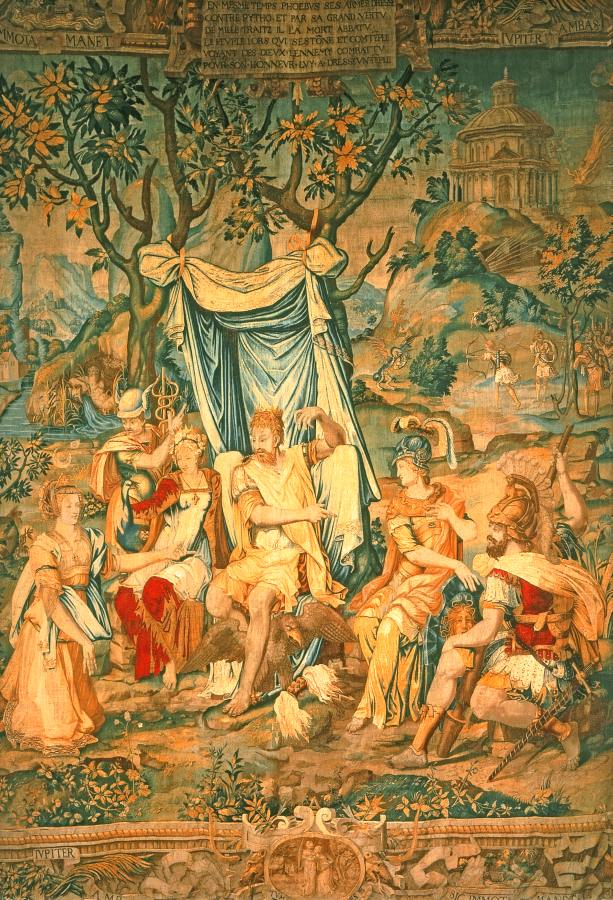
    I find that one of the easiest-to-see examples of horoscopes concealed in artwork is one of the tapestries allegedly portraying Henry !! with Diane Poiters. It appears as Fig. 2.27 in Fomenko’s book Russian and Italian Zodiacs. It can be directly accessed here: https://chronologia.org/egruit_zodiaki/im/g3_2-027.jpg

    In the middle of this tapestry we see a male figure sitting on a throne. At his feet, we see an eagle pecking at a lightning bolt. This figure could be Zeus, since the eagle is one of his symbols and Zeus is a ruler. (You may need to use the Zoom function on your computer to enlarge the image or use a magnifying glass for details).

    To the central figure’s right (viewer’s left) we see, in the distant background, a seated figure holding on to a capsized urn from which a river of water is issuing. This could be Aquarius – if the astrological allegory holds going forward. In the foreground, we see a male and two females. The male is holding a caduceus. This would be Mercury of course… the allegory is holding!. One of the females is a young beauty holding a peacock. This would be Venus. In the closest foreground, we see a woman with a lunar crescent over her head – the Moon obviously.

    So, we may have a depiction of Mercury, Venus, and the Moon in Aquarius.

    If we look to the central figure’s left (the viewer’s right), we see an archer in the distant background. This would be Sagittarius (the Archer). In the foreground, there are two male figures, one younger, one older. These could correspond to Mars and Saturn respectively located in Sagittarius.

    For various reasons a process of elimination as I recall, Fomenko assigns Jupiter to Capricorn, the constellation between Aquarius and Sagittarius. I think a further reason for such an assignment, not mentioned by Fomenko, would be that this central figure has only one foot on the ground, a possible allusion to Capricorn as the One-Footed Goat.

    In any event, when this configuration of planets is entered into a computer, we get a date of February 28-March 1,1546 CE, very close to the year historians estimate for the creation of the tapestry. This is evidence that horoscopes really were concealed in Medieval artwork and that such artwork may be datable on the basis of such horoscopes.

  3. Larry Richardson Avatar
    Larry Richardson

    Another very important horoscope that is not discussed in any of Fomenko’s English language publications is the horoscope Fomenko discovered in myth of the twelve labors of Hercules. It is discussed in Fomenko’s book “Hercules. Ancient Greek Myths of the 16th Century.” That book was a game-changer for me. Years ago, I had read most of volumes 1 – 3 of “History, Truth or Fiction,” but I was unconvinced. Confronted with the new horoscopes in the Hercules book, I began to believe the Fomenko chronology on Mondays, Wednesdays, and Fridays. At present, I accept most of Fomenko’s conclusions six days a week. I still have reservations on Sundays.

    The twelve labors of Hercules immediately suggests the twelve signs of the Zodiac. Eleven of the signs are readily identifiable from the story context. Diverting a river to clean the Augean stables easily brings Aquarius, the Water Bearer to mind. Killing the Nemean Lion is a no-brainer for Leo, etc. Gods and/or goddesses mentioned in the context of a sign can be investigated for location of the mentioned planet(s) in a specific sign. Pisces is the only sign not identifiable, but it is of little importance because all the planets seem to be locatable in other signs. (Pisces seems to be replaced in the narrative by Ursa Major and Minor, described as the fleshing-eating Mares of Diomedes Hercules must steal in the one labor outside the Zodiac belt).

    The open-source HOROS computer program allows various interpretations to be tested for possibility. Some interpretations are impossible in terms of orbital mechanics (the inner planets Mercury and Venus must not be too far from the Sun), other interpretations can be impossible over the time period studied.

    In the case of the Hercules horoscope, the entire time period from 3000 BCE to present was searched by computer and only one, unique solution emerged: November 17-21, 1513 CE.
    This was the alleged year when the humanist, grecophile Leo X ascended to the papal throne. It is thought he officially came to power in the middle or later part of that year, so, Fomenko has hypothesized that The Twelve Labors of Hercules was written for him either as a celebration for the actual ascension to the throne or to mark some celebratory gift given to him in that year.

    Over course, if that were true it would throw the whole history of Rome and Greece into disarray, since so many Classical authors refer to the Twelve Labors and would have to be relocated to the Medieval/Renaissance period.

    A few months ago, I read a news announcement of a recent discovery made while cleaning the Papal throne. The workers found the twelve labors of Hercules carved along the bottom of the throne. I wish I would have bookmarked the news item. It looks like another one-in-one for Fomenko.

Leave a Reply

About the author

Stephen Sorensen is an independent researcher specializing in deception studies. He publishes ai-free work on an ad-free website to help educate others who share the same interests.

Get updates

Spam-free email subscription, we guarantee. This is just a friendly ping when new content is out.

Discover more from Ctruth

Subscribe now to keep reading and get access to the full archive.

Continue reading